


In June 2026, Western Europe experienced a rapid onset of drought conditions after parts of the region had begun the year with comparatively favourable rainfall. Successive heatwaves raised atmospheric evaporative demand, accelerating the loss of moisture from vegetation and soils alongside the effects of reduced rainfall. Attribution analysis found that climate change had made the observed highly evaporative conditions approximately 80 times more likely in Western Europe and 40 times more likely in Eastern Europe, relative to their respective historic assessment periods (“the Signal”).[1][2]
The economic consequences became visible in July’s agricultural forecasts, which reduced expected grain production across the EU and UK by almost 9mn tonnes. The gross value of downward revisions was estimated at €2bn–€2.3bn, with France recording the largest projected losses, while upward revisions elsewhere reduced the net value change to about €1.8bn (“the Value”).[3][2] The knock-on consequences extended through feed markets, agricultural trade, and food supply chains.
Those revisions measure a loss expected from one season’s harvest, which is only part of the wider story. The capacity to withstand such a seasonal episode also depends on the condition of the soil-water system supporting production. Where degradation has reduced the water available to roots, heat and low rainfall act on a system with less capacity to sustain the crop.[4]
Historical observations provide the priors for future cash flows. Where climatic and ecological conditions are carried forward through relatively stable operating assumptions, water is expected to remain available for production and cooling, soil to retain moisture within established ranges, and agricultural yields to fluctuate around historical relationships.
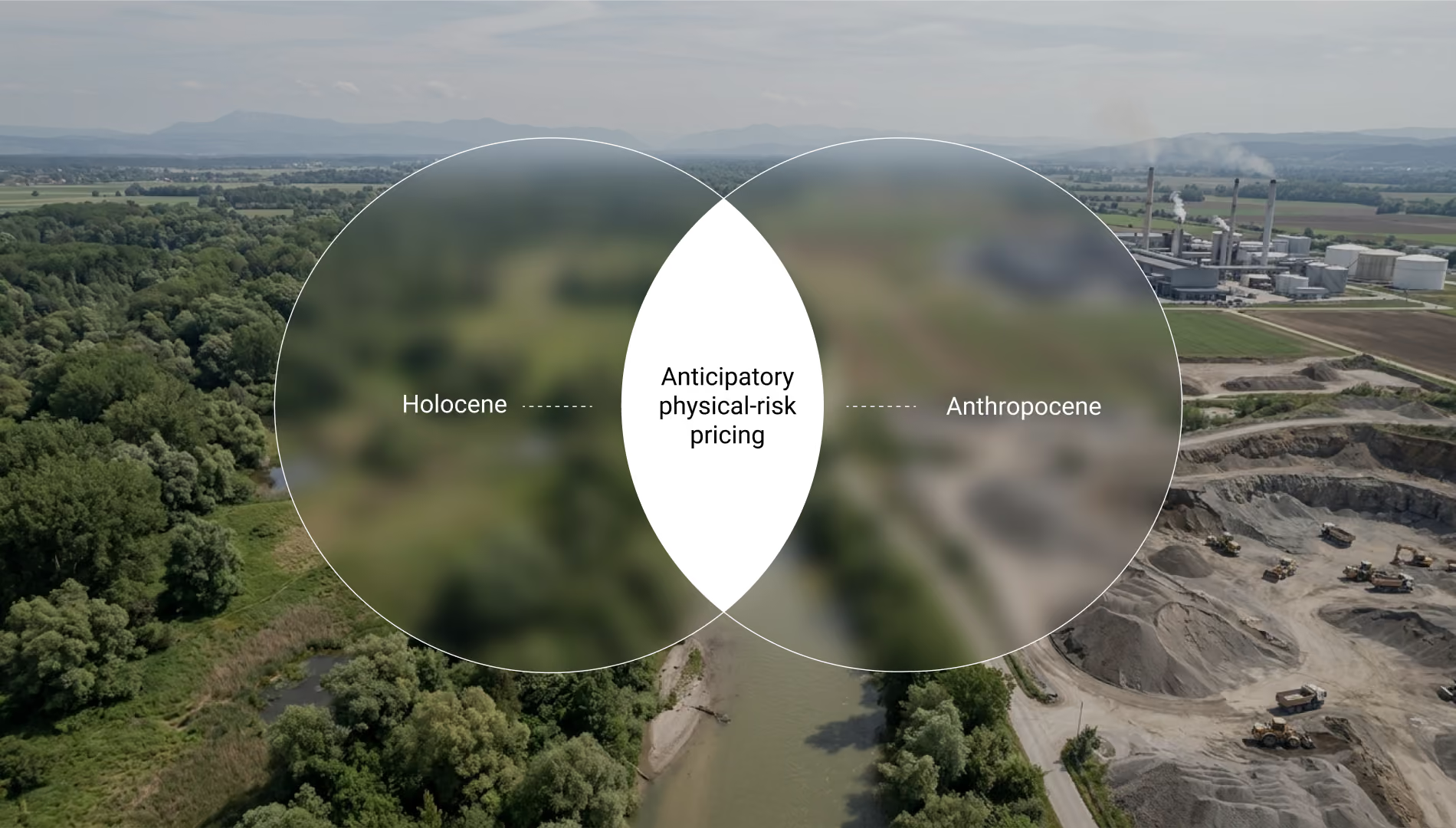
Those relationships were observed principally under the comparatively stable climatic conditions of the Holocene. As human activity changes the climate and the ecological systems supporting production, historical continuity becomes a progressively less secure basis for estimating future performance under the conditions commonly described as the Anthropocene.
The system beneath the shock
Climate and nature are often analytically decomposed into separate domains, when in reality the physical processes connecting them are inextricably intertwined. In the soil-water system, the condition of the soil influences both a crop’s access to water and the exchange of moisture and heat with the atmosphere.[5] Organic matter helps stabilise soil aggregates and supports the pore networks through which rain enters the soil and roots access water. Erosion reduces the soil volume available to store water, while compaction can restrict infiltration and root access.[4]
Long-term European records show how improved farming methods and mineral fertilisation can raise agricultural output while soil organic carbon declines.[6] These productivity gains can conceal deterioration in the natural capital supporting production, with similar crop yields masking differences in the soil’s capacity to store water that plants can access.[7] Fertilisation can replace nutrients without rebuilding the physical capacity that carries a crop through a dry spell. Historical production can therefore reflect improvements in farming while giving an incomplete account of the condition of the soil on which future performance depends.
Favourable early-season rain can therefore offer limited protection when heat depletes the water stored in the rooting zone. A soil with a smaller accessible reserve can reach the point of crop water stress sooner under the same weather conditions.[4] The loss of moisture can then feed back into the climatic stress. Once moisture becomes limiting, less energy is used for evaporation and transpiration and more heats the land and the air above it, which can intensify and prolong heatwaves.[8] Higher temperatures, in turn, increase atmospheric demand for water, adding to pressure on the remaining moisture.[1]
This feedback is recursive, with climatic and human pressures altering an emergent ecological state that then changes the conditions through which subsequent pressures operate. Soil, water, vegetation, and climate are simultaneously the products of prior interactions and inputs into subsequent ones, with effects propagating through nested feedbacks across spatial and temporal scales.
Such complex systems rarely admit a clean decomposition into independent causal contributions. Their outcomes emerge through feedbacks, thresholds, and interactions whose combined effects may be extraordinarily difficult to anticipate, even where the underlying processes are entirely deterministic. An emergent state may be fully determined by preceding conditions and interactions, yet remain inaccessible through any explanatory route shorter than simulating the dynamics that produce it.[9] Causal determination can therefore coexist with profound limits on our capacity to reconstruct or predict the resulting outcomes.
For financial analysis, the task is to translate physical evidence into economic consequences, linking “the Signal” to “the Value”.[2] Ecological deterioration can change the distribution of future economic outcomes before its effects can be reliably assigned to particular operating variables, periods, or financial magnitudes. Current physical-risk information can therefore be relevant to valuation before its consequences appear in historical financial returns.
Booking principal as income
The information available to finance also depends on how economic performance is recorded (“the Book”).[2] For much of modern economic history, climatic and ecological functions appeared sufficiently reliable or abundant at the margin to carry little explicit price. Their contribution to productive capacity was consequently recorded more readily through economic output than through changes in the condition of the natural capital supporting that output.
That accounting asymmetry reflects the combined effects of apparent abundance, incomplete markets and property rights, and measurement systems that capture economic production more consistently than the depletion or restoration of its ecological foundations.
Where production draws down groundwater reserves or soil nutrients and composition, recorded output can coexist with a reduction in the natural capital capable of supporting future production. Economic accounts then recognise the flow generated during the period while leaving part of the reduction in the underlying productive stock unrecorded. In that sense, natural capital can be consumed while the resulting production is booked as income.
Nature is a productive system whose condition determines its capacity to generate future ecosystem-service flows. An economy that draws down the underlying stock can therefore record rising current output while inclusive wealth, and the capacity to sustain future output, decline. GDP measures economic activity and does not, by itself, deduct depreciation of natural capital, which is why stock-based measures of wealth are necessary alongside measures of current production.[10]
Economic prices respond to scarcity and expectations regarding future supply. Where ecological capacity becomes less reliable, its remaining contribution can become more valuable and the economic cost of further impairment can rise. Financial claims on future production consequently depend on the extent to which deterioration in productive capacity is already reflected in expected cash flows and the risks attached to those flows.
Stability can conceal fragility
The timing of that recognition also depends on expectations formed during periods of reliable performance. Minsky's financial-instability hypothesis describes how extended periods of apparent stability can change behaviour in ways that increase fragility. Benign experience reduces perceived risk, financing structures come to rely more heavily on favourable conditions continuing, and the absence of failure appears to validate the arrangements through which fragility accumulates.[11]
The ecological analogy follows the same behavioural mechanism. Businesses and financial institutions form expectations about future output from historically observed operating performance, even where the physical systems sustaining that performance are changing beyond the company's legal and accounting boundary. A long period of reliable production can thereby reinforce expectations of continuity while underlying ecological resilience deteriorates.
Interventions can extend the interval between ecological deterioration and financial recognition. Irrigation and synthetic inputs can sustain agricultural production, while additional cooling can preserve industrial operations and insurance can transfer losses despite increasing physical stress. Some interventions provide genuine and durable resilience, while others preserve economic performance without necessarily restoring the ecological capacity on which that performance ultimately depends. Where those measures preserve financial performance, historical returns can give little indication of the loss of physical buffering capacity or the larger losses possible during a severe shock.
Once an ecological threshold is crossed, or a hazard exceeds the remaining protective capacity of the physical system, several financial consequences may emerge together. Forecast cash flows can fall, insurance can retreat, collateral values can weaken, and investors or lenders can reassess the risks embedded in their claims. Financial recognition can appear sudden even where the underlying deterioration has accumulated over many years.
The limits of the Minsky analogy become most apparent in the response to a crisis. A conventional financial crisis principally concerns the liquidity, solvency, and value of financial claims against an underlying economy. Central banks and governments can, within limits, intervene through liquidity provision, guarantees, recapitalisation, restructuring, and fiscal transfers, stabilising financial institutions and sustaining economic activity while losses are absorbed or redistributed. The effectiveness of those interventions ultimately depends on the productive capacity of the economy remaining sufficiently intact to support recovery.
An ecological crisis can impair that productive capacity itself. Once critical thresholds are crossed, the physical systems supporting economic activity may enter substantially altered states, with recovery requiring physical intervention and time. Some losses may be irreversible on timescales relevant to economic activity and human welfare.[12]
That physical constraint limits what financial institutions and governments can achieve in response. A central bank may be able to preserve liquidity following a damaged harvest, but it cannot restore the soil-water system required to produce that harvest within the season in which the relevant obligations fall due. Financial intervention can fund a physical response, although the timing and effectiveness of recovery remain governed by the underlying ecological processes. The capacity to bail out financial institutions therefore offers no assurance that the productive systems supporting their claims can be restored within an economically meaningful horizon.[2]
Where the risk belongs
These limits on recovery strengthen the case for recognising changing physical risk before it appears in realised financial losses. Where the depletion of ecological productive capacity remains absent from conventional accounts, historical earnings and financial returns can continue to suggest stability while the physical conditions sustaining them deteriorate. Parameters estimated from past returns, including equity beta, may consequently provide limited information about the changing distribution of future outcomes, particularly where ecological deterioration has yet to generate observable financial losses or where historical relationships are becoming less representative.
Financial theory provides the framework for allocating the resulting risk. Consequences that can be estimated with sufficient integrity belong in expected cash flows, while required-return treatment depends on the nature of the risk and the financial claim through which it is borne. For equity, localised losses may be diversifiable for the marginal market investor, whereas correlated deterioration across productive systems can generate systematic risk capable of affecting market-wide returns.[13] Concentrated investors may bear additional risks within their particular portfolios, while creditors and insurers face corresponding consequences through default, recovery, and insured losses.
Research has associated concentrated ecosystem-service dependencies, particularly those involving water, with greater downside equity risk.[14] That finding reinforces the financial relevance of ecological dependencies in valuation. The resulting question is how current physical-risk information should enter financial decisions where existing inputs provide an incomplete account of the exposure.
Pricing before the loss
Shadow pricing offers a transitional route from physical-risk assessment to financial valuation. Our white paper develops the Physical Risk Adjustment (PRA), a judgementally calibrated adjustment to the cost of equity that uses current physical-risk information to reflect material residual exposure borne by the investor in holder-specific valuation.[15]
The purpose of recognising such risk is anticipatory. Europe's grain forecasts were revised once the developing heat and drought made the expected production shortfall sufficiently observable, by which point many of the season's planting, financing, and operational decisions had already been taken. Assessing the soil’s ability to capture and supply water alongside the climatic hazard could have informed those decisions, including capital allocation and the economic case for investments that preserve or restore ecological resilience.
The Holocene provided a historical record against which the productive capacity of natural systems appeared sufficiently stable to be treated as a largely dependable input in financial valuation. Where intensifying climatic hazards meet a deteriorating productive stock, relying on historical financial performance without adequately recognising the loss of physical resilience risks leaving capital allocated against expectations that the system can no longer sustain. The purpose of anticipatory physical-risk pricing is to recognise that exposure while there remains an opportunity to respond, before the physical system imposes a correction that financial intervention alone cannot reverse.
Scope and limits
The soil evidence supports the link between ecological condition and productive capacity; it does not quantify a Europe-wide loss of water-holding capacity, isolate prior degradation’s contribution to the 2026 drought’s onset or harvest revisions, or establish financial mispricing. Market prices can incorporate information beyond reported accounts, so an accounting omission becomes a valuation gap only where material consequences remain outside expected cash flows and existing risk assumptions. Evidence associating ecological dependencies with downside risk does not isolate a separately priced market factor. The PRA is a judgementally calibrated adjustment for residual exposure borne by the relevant holder and excluded from those existing inputs; it is distinct from the market-level Physical Risk Premium (PRP) for systematic risk borne by diversified investors, whose empirical identification and calibration remain open questions.[15]
Endnotes
[1] World Weather Attribution, 'Increasingly hot Europe faces more severe droughts and growing challenges for water and land management', 23 July 2026. The attribution estimates relate to highly evaporative conditions observed over April–June in western Europe and January–June in eastern Europe; see also Emiliya Mychasuk and Steven Bernard, Financial Times, 23 July 2026.
[2] Martin R. Stuchtey, Too Big to Bail: A Playbook for Recapitalising the Living World, oekom verlag, forthcoming December 2026. ISBN 978-3-676-07002-7.
[3] Susannah Savage, ‘European heatwave wiped €2bn from value of grain crop, analysis estimates’, Financial Times, 22 July 2026; Energy and Climate Intelligence Unit, ‘June heatwave knocks €2 billion off European harvest prospects – new analysis’, 22 July 2026. The almost 9mn-tonne reduction is net of upward revisions elsewhere, while €2bn–€2.3bn is the gross value of downward revisions under different price assumptions; the net value reduction was approximately €1.8bn. The figures describe contemporaneous forecast revisions and estimated production values.
[4] Guillaume Blanchy et al., 'Soil and crop management practices and the water regulation functions of soils: a qualitative synthesis of meta-analyses relevant to European agriculture', SOIL 9 (2023), 1–20; John N. Quinton, Lena K. Öttl, and Peter Fiener, 'Tillage exacerbates the vulnerability of cereal crops to drought', Nature Food 3 (2022), 472–479; Budiman Minasny and Alex B. McBratney, 'Limited effect of organic matter on soil available water capacity', European Journal of Soil Science 69 (2018), 39–47.
[5] Intergovernmental Panel on Climate Change, Climate Change 2022: Impacts, Adaptation and Vulnerability, Summary for Policymakers, Figure SPM.1. The report expressly frames climate, ecosystems, biodiversity, and human society as coupled systems whose interactions form the basis of emerging risks.
[6] Marie Spohn, Sabina Braun, and Carlos A. Sierra, 'Continuous decrease in soil organic matter despite increased plant productivity in an 80-years-old phosphorus-addition experiment', Communications Earth & Environment 4 (2023), 251; Laura Sofie Harbo et al., 'Soil Organic Carbon Changes in Agricultural Areas of Europe, Synthesis of Repeated Regional Soil Surveys', European Journal of Soil Science 77, no. 1 (2026), e70263.
[7] Andrea D. Basche et al., 'Soil water improvements with the long-term use of a winter rye cover crop', Agricultural Water Management 172 (2016), 40–50; Alison E. King, Eunkyoung Choi, Jesse Burkhardt, and Nathaniel D. Mueller, 'Soil Organic Carbon Improves Crop Yield and Yield Resilience', Global Change Biology 32, no. 5 (2026), e70909.
[8] Erich M. Fischer, Sonia I. Seneviratne, Daniel Lüthi, and Christoph Schär, 'Contribution of land-atmosphere coupling to recent European summer heat waves', Geophysical Research Letters 34 (2007), L06707.
[9] Mark A. Bedau, 'Weak Emergence', Philosophical Perspectives 11 (1997), 375–399; Richard Levins, 'The Strategy of Model Building in Population Biology', American Scientist 54, no. 4 (1966), 421–431. The references support the discussion of emergent complexity, feedbacks, and the limits of model simplification.
[10] Partha Dasgupta, The Economics of Biodiversity: The Dasgupta Review, HM Treasury, 2021; Office for National Statistics, Inclusive income and wealth, UK quality and methods guide, 2025. Both distinguish current economic output from the condition and depreciation of the stocks supporting future productive capacity.
[11] Hyman P. Minsky, "The Financial Instability Hypothesis", Working Paper No. 74, Jerome Levy Economics Institute, 1992. The analogy used here concerns the endogenous accumulation of fragility during periods of apparent stability.
[12] Intergovernmental Panel on Climate Change, Climate Change 2023: Synthesis Report, Summary for Policymakers, on adaptation limits, escalating losses, and the risk of irreversible change in natural systems.
[13] William F. Sharpe, 'Capital Asset Prices: A Theory of Market Equilibrium under Conditions of Risk', Journal of Finance 19, no. 3 (1964), 425–442; Robert C. Merton, 'An Intertemporal Capital Asset Pricing Model', Econometrica 41, no. 5 (1973), 867–887. These references provide the theoretical basis for risk compensation linked to market-relevant states.
[14] Alexandre Garel, Arthur Romec, Zacharias Sautner, and Alexander F. Wagner, 'Firm-level nature dependence', Review of Finance 30, no. 1 (2026), 231–272. Higher concentrated dependence, particularly on water-related ecosystem services, is positively associated with downside-risk measures.
[15] The Landbanking Group, Climate- and Nature-Related Physical Risk in Equity Valuation, concept paper (September 2026), especially Sections 1–3 and 6–7.