


Proving climate and nature outcomes on the ground
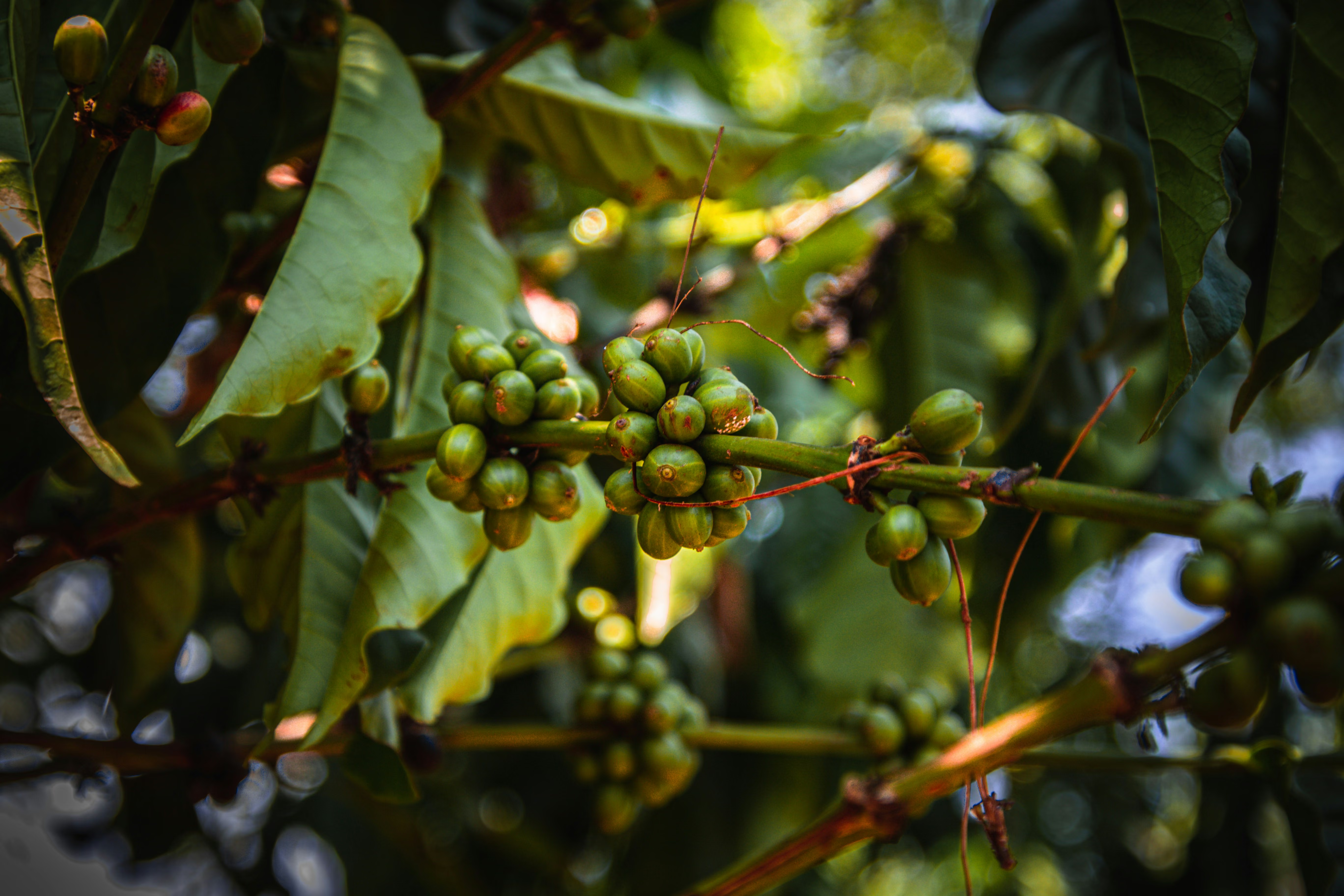
The Integrated Carbon and Coffee-based Livelihoods Project supports 2,000 smallholder coffee farming families in Mbinga district, Ruvuma region, strengthening livelihoods through agroforestry and long-term farm resilience.
But without a reliable, scalable system to track carbon sequestration, water holding capacity, and biodiversity, Hanns R. Neumann Stiftung (HRNS) could not demonstrate that its agroforestry practices were outperforming conventional farming. Connecting farmers to the voluntary carbon market required evidence: data rigorous enough for carbon market buyers and institutional reporting, while still clear and meaningful for farming families, cooperatives, and development partners.
Declining rainfall, down by up to 27 mm across the project area since 2018, and degraded soils compounded the challenge. HRNS needed to show that tree-based production systems were delivering measurable gains across carbon, water, and biodiversity, alongside farmer training, nursery development, and stronger farmer organizations.
Building a baseline for ecological change
The Landbanking Group deployed Landler, its AI-powered natural capital measurement platform, across HRNS's 500-hectare project area in the Mbinga district.
Using satellite imagery and geospatial analysis, Landler established continuous monitoring of below-ground carbon storage, water holding capacity, soil moisture, and precipitation trends at both the individual plot and regional cluster level. This gave HRNS a time-series view of ecological change going back to 2018, against which the impact of its multi-strata agroforestry system — 112 trees per hectare across three canopy layers — could be directly measured.
With the baseline in place, HRNS could compare conditions before and after agroforestry interventions and see where ecological performance was improving, where variability remained, and where additional support was needed.
Turning monitoring data into carbon market infrastructure
The platform's verification capability was critical to unlocking HRNS's carbon market ambitions. Monitoring data alone does not create a bankable natural capital asset; it has to be translated into a credible, traceable framework that buyers can trust.
The Landbanking Group translated Landler's verified sequestration data into a structured commercial framework, identifying a verified volume of nature-linked carbon outcomes across the 30-year project horizon. The AI-based MRV methodology supports future market engagement with traceability to individual farming plots.
What had been an ecological and livelihood project became a measurable natural capital asset, backed by independent, AI-based MRV and environmental performance data.
Communicating impact across buyers, partners, and farmers
HRNS gained the ability to communicate impact with confidence. The Landbanking Group transformed complex environmental datasets into clear, stakeholder-ready insights, giving HRNS a single source of truth for carbon buyers, development partners, donor reporting, and the 2,000 farming families whose livelihoods depend on the land being restored.
Landler's monitoring confirmed a steady upward trend in below-ground carbon storage across all enrolled plots since 2018. In the Mundeki cluster alone, 36 plots covering 28.9 hectares, the 10-year carbon uplift potential stands at +33.5%, with a current baseline of 58.83 t CO₂/ha. Across the full project, total CO₂ sequestration is projected at 141,979 tonnes over 30 years, supported by a verified, market-facing evidence base.
Water-holding capacity data told an equally compelling story. Despite regional precipitation declining across all monitored plots, some farms improved their soil water storage by over 228 m³/ha, a direct result of agroforestry practices improving soil structure. HRNS now has the data to demonstrate, plot by plot, where intervention is working and where additional support is needed.
The Landbanking Group also developed tailored impact reports that visualize environmental metrics in formats suited to different stakeholders, from sequestration analyses for carbon buyers and institutional reporting to clearer farm-level summaries for cooperatives and field teams. For an organization working across 2,000 smallholder families, presenting a coherent, credible impact narrative to donors, partners, and markets at the same time is the foundation of long-term program viability.