

General information, not legal advice. National implementation and enforcement can vary, so specific claims should be reviewed in the markets where they will appear.
In this guide
- What is EmpCo, why marketing owns it, and why it’s important
- Who and what are covered
- Two legal buckets marketing teams need to understand
- Claims and practices most likely to cause trouble
- The tone-of-voice shift
- Before and after: translating common claims
- How a claim moves from evidence to market
- What happens when a claim is challenged
- How The Landbanking Group can support you
- The pre-publication checklist
- Frequently asked questions
- Further reading
What is EmpCo, why marketing owns it, and why it’s important
EmpCo is the common shorthand for Directive (EU) 2024/825 on empowering consumers for the green transition. From 27 September 2026, it changes what businesses may say—or imply—about the environmental and social characteristics of products and businesses when marketing to consumers in the EU.
It amends the Unfair Commercial Practices Directive and the Consumer Rights Directive. The rules reach much further than advertising copy: product and brand names, packaging, imagery, badges, ecommerce pages, future targets, comparisons, guarantees and repair information can all be caught.
For marketing teams, the central rule is simple: sustainability-related communication must be backed by evidence and must not expand beyond it.
In practice:
- Broad terms such as “green” or “sustainable” face a high bar.
- A narrow benefit cannot be presented as a benefit of the whole product or business.
- Product climate claims cannot use offsets outside the value chain to create a neutral, reduced or positive impact.
- Sustainability labels need a qualifying public basis or certification scheme.
- Future promises need measurable milestones, a credible implementation plan and independent review.
- Product-life, guarantee, repair and software-update information also fall within the rules.
The opportunity is specificity. A result tied to a real product, supplier, place and period is more credible—and harder for a competitor to imitate—than generic sustainability language.
The brands that benefit most from EmpCo will be the ones with a clear evidence base to back up their claims.
EmpCo does not create one EU regulator or a uniform penalty system. It places EU-wide requirements inside national consumer-protection regimes, so enforcement routes and remedies can vary by country.
It should also not be confused with the separate Green Claims Directive proposal. As of 21 September 2026, that proposal remains pending. EmpCo is already adopted law and applies from 27 September 2026.
Who and what are covered
EmpCo operates mainly within the EU’s business-to-consumer framework. It can apply to manufacturers, retailers, brand owners, service providers, ecommerce businesses and other traders marketing products or services to consumers in the EU. The business does not need to be based in the EU; directing sales or marketing towards EU consumers can be enough.
The rules follow the claim across its publication footprint:
- Owned channels: websites, ecommerce, email, social content and QR-code destinations.
- Physical channels: packaging, labels and point-of-sale material.
- Third-party channels: retailer, marketplace and distributor listings that reproduce the brand’s wording.
Purely B2B and investor communications generally sit outside the harmonised B2C perimeter, although national rules may go further. The same content can also enter scope when it is reused in consumer marketing.
Existing stock is also covered
There is no blanket exemption for claims printed or published before 27 September 2026. The relevant date is when the consumer encounters the commercial practice, not when the packaging was designed.
The Commission’s June 2026 Q&A nevertheless recognises genuine practical constraints and says authorities may consider reasonable and proportionate compliance efforts. That is not a transition period: the business still needs a prompt, documented remediation plan.
Prioritise product-neutrality claims based on offsets, unauthorised labels, unsupported whole-product claims and high-volume wording. The final record should link each claim to affected volumes, markets, chosen action and completion date.
Two legal buckets marketing teams need to understand
EmpCo strengthens the rules in two different ways. The distinction determines how a claim is assessed.
Bucket A: prohibited in all circumstances
The first bucket consists of practices added to Annex I of the UCPD—the blacklist. If a communication matches one of these patterns, an enforcer does not need to show that it changed the average consumer’s purchasing decision. Good intentions or extra substantiation cannot rescue the prohibited practice; it needs to be removed or fundamentally changed.
Bucket B: assessed in context
The second bucket operates through the UCPD’s rules on misleading actions and omissions. Here, the complete communication matters: wording, evidence, prominence, imagery, omitted information and the likely effect on the average consumer. These claims are not automatically prohibited, but they must be reviewed and substantiated in their actual context.
“Assessed in context” does not mean low-risk. It means the answer depends on the claim’s evidence, presentation and likely consumer effect rather than on the presence of a blacklisted pattern.
The claims and practices most likely to cause trouble
EmpCo reaches more than explicit copy. Product and company names, trademarks, badges, icons, imagery, colours and the overall presentation can all communicate an environmental claim. A registered trademark does not create an exemption: the relevant question is what the average consumer is likely to understand from the complete presentation.
The tone-of-voice shift: from aspiration to evidence
Sustainability marketing has spent a decade reaching for warmth and scale: bold language, universal benefits and promises large enough to fit a billboard.
EmpCo pushes in the opposite direction. A defensible claim often reads less like a slogan and more like a well-written caption. It tells the audience what was measured, what changed, what the result covers and where its limits sit.
That does not require dead copy. Specificity can make a claim more interesting because it replaces borrowed virtue with an observable fact.
Compare:
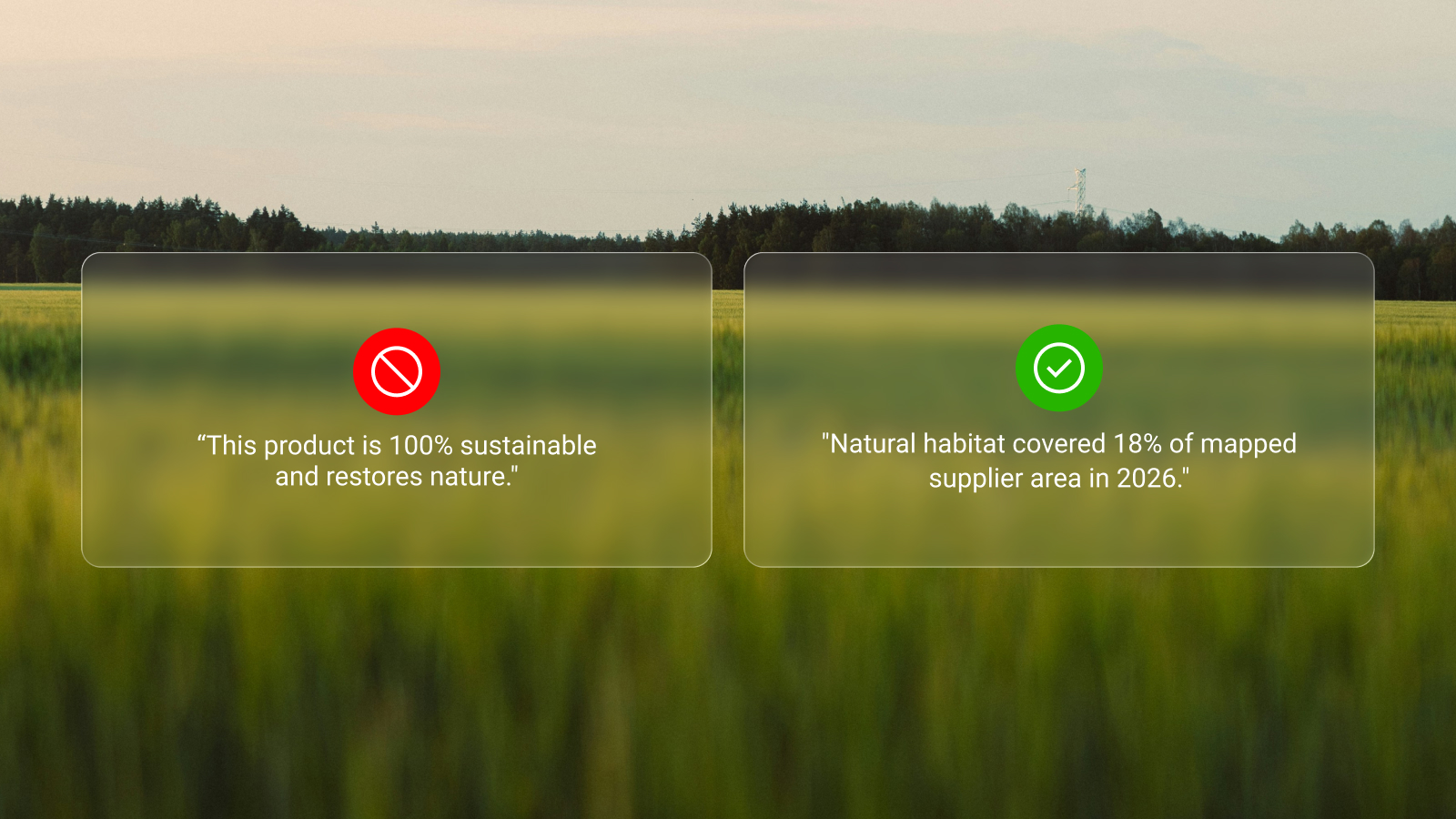
“Better for nature.”
with:
“Natural habitat covered 18% of the mapped supplier area in 2026, up from 14% in the 2023 baseline.”
The second sentence contains something a reader can understand, test and remember. It also gives the writer useful material: a result, a place, a period and a direction of travel.
The claim test
A result can be real without supporting the larger story a headline implies.
Before and after: translating common claims
These examples show a compliant direction, not pre-approved wording. Every real claim still needs evidence and legal review in its actual context.
How a claim moves from evidence to market
The hardest part of EmpCo is maintaining the connection between a fact, the product it relates to and every place the resulting claim appears. Consider a chocolate brand sourcing cocoa from mapped supplier plots:
The result is real, but it does not yet justify printing “deforestation-free chocolate” on the wrapper. The sections below show how to close that claim–evidence gap.
Start with the exact claim—and map every proposition to evidence
A review cannot approve a theme such as “deforestation” or “biodiversity.” It must assess the words the consumer will see and the propositions they imply. “Deforestation-free,” for example, suggests that no relevant deforestation occurred, the full sourcing area was covered, the monitored cocoa entered this product and the result remains current. If the evidence establishes only that no deforestation was detected on mapped plots during a defined period, the wording must remain inside that boundary.
“No deforestation was detected on the mapped plots supplying this cocoa programme during 2025–2026, based on [method]. The mapped plots represented X% of the cocoa sourced for this product during that period.”
Each material element of the final sentence needs corresponding support. The result needs its method, boundary, period, resolution and limitations; a comparison needs a baseline and consistent unit; and a causal verb such as “restored” or “improved” needs evidence of attribution, not merely evidence that two things happened at the same time.
Translate nature indicators without overclaiming
Nature data is especially vulnerable to scope drift because familiar terms such as “biodiversity”, “regenerative” and “deforestation-free” carry more meaning than a single indicator can usually establish.
The route from indicator to claim should preserve the method, resolution, period, geography, coverage, uncertainty and product linkage.
Connect the environmental result to what is sold
Nature data may show what happened on a field, farm or landscape, while the consumer claim appears on a product. The evidence file therefore needs to connect the monitored area to the relevant supplier, ingredient, batch, sourcing programme or SKU and state what proportion of the product was covered. Without that chain-of-custody or product link, the result describes land associated with the business—not necessarily the product in the consumer’s hand.
Test the complete consumer impression
A narrow sentence can still create an overbroad impression when it appears under a name such as “Forest Positive,” beside a green seal or against imagery suggesting that buying the product restores nature. Review the words, name, imagery and placement together, and put any qualification needed to understand the claim’s scope on the same medium; a distant methodology page cannot repair an impression the main communication has already created.
Control the approved claim over time
Measurement establishes what the data shows; assurance assesses the method, process or reported result; certification confirms conformity with a scheme and may authorise a label. These layers can support one another but are not interchangeable, and each supports only the characteristics and wording within its scope.
Marketing should therefore receive approval for an exact claim—not permission to improvise around a theme—and the approval should identify every channel in which that wording may appear. “No deforestation was detected on mapped supplier plots during 2025–2026” does not also approve “deforestation-free product,” “forest positive” or “protecting forests with every purchase.”
The claim also needs an owner, review date and triggers for reopening the evidence file when suppliers, products, methods, data or certifications change. Managed this way, a strong environmental claim becomes a durable marketing asset with defined evidence, scope, distribution and life.
What happens when a claim is challenged
EmpCo does not create one EU regulator or one uniform penalty table. It places new rules inside the consumer-protection and unfair-competition systems that already operate in each Member State. The first challenge may therefore come from a national authority, but it can also come from a competitor, consumer organisation or qualified entity seeking an injunction or representative remedy. In markets with active private enforcement, the first sign of trouble may be a rival’s letter rather than a regulator’s audit.
The immediate commercial consequence is often more disruptive than the fine: a campaign may need to stop, packaging may need to be corrected, retailer content may need to be recalled and the business may have to defend a claim whose evidence is scattered across teams. The quality of the claim file therefore matters not only at approval but at the moment of challenge, when the company needs to reconstruct quickly what was said, where it appeared and what supported it.
The widely repeated “4% of turnover” figure needs context. For widespread infringements and widespread infringements with a Union dimension pursued through the EU’s coordinated consumer-enforcement framework, Member States must provide for the possibility of fines whose maximum is at least 4% of annual turnover in the Member State or Member States concerned. Where turnover information is unavailable, the maximum must be at least €2 million. National law may set higher ceilings or extend similar penalties further, but it is inaccurate to say that every EmpCo mistake automatically produces a 4% fine.
The practical point is simpler: environmental copy now sits inside a mature enforcement system. A business should be prepared to explain the consumer impression, produce the evidence and show the review process—not merely assert that the statement was intended in good faith.
How The Landbanking Group can support you
Through Landler, The Landbanking Group can make the evidence behind nature-related claims usable by carrying the method, spatial resolution, time window, boundaries and limitations alongside each indicator. That helps reviewers see what a result supports before it reaches a marketing brief.
Landler contributes evidence; it does not turn measurement into certification or legal clearance. Where a business wants to use a sustainability label or certification-style wording, the relevant scheme and independent verifier remain separate.
The pre-publication checklist
Before approving a consumer-facing environmental or sustainability claim, confirm:
☐ We have reviewed the words, imagery, colours, badges and product name together.
☐ The claim does not use a generic environmental term without the required recognised performance or a clear, prominent specification.
☐ The claim refers only to the product, component, geography and activity covered by the evidence.
☐ It does not turn a packaging or component benefit into a whole-product claim.
☐ Any sustainability label is established by a public authority or based on a qualifying certification scheme.
☐ Any greenhouse-gas product claim does not achieve a neutral, reduced or positive impact through offsetting outside the value chain.
☐ Any future target has a public, realistic and detailed implementation plan with measurable milestones and independent review.
☐ Any comparison states its baseline, unit, boundary, period and method.
☐ The claimed benefit is relevant rather than merely true.
☐ The evidence existed before publication and can be produced if challenged.
☐ Chain-of-custody or product-linkage evidence connects the result to the product named.
☐ Limitations and uncertainty are disclosed where they are material to consumer understanding.
☐ Supporting information is clear, prominent and easy to reach.
☐ Marketing, technical or sustainability, and legal reviewers approved the same final wording.
☐ The claim has an owner, review date and retirement trigger.
☐ Retailers, distributors and third parties have received the approved wording.
☐ Existing stock and historical digital content have been included in the remediation plan.
Frequently asked questions
Does EmpCo ban the word “sustainable”?
Not as an isolated dictionary word. It prohibits generic environmental claims where the required recognised excellent environmental performance relevant to the claim cannot be demonstrated. The meaning created by the full communication and its context matters.
In practice, “sustainable” is an exceptionally broad word. Most product-specific evidence supports a narrower factual claim more safely and more usefully.
Can a footnote fix a broad claim?
Not automatically. A qualification needs to be clear and prominent enough to prevent the main communication from creating a misleading impression. A distant methodology page cannot be assumed to cure an overbroad headline.
Are B2B claims outside EmpCo?
The harmonised UCPD framework is primarily B2C. But national law may extend similar principles, and B2B or investor content can be caught when repurposed in consumer-facing commercial communication. Treat the audience and use of each communication as facts to check, not assumptions.
Can we still talk about carbon credits?
Businesses can describe support for projects or the purchase of credits accurately. The prohibited pattern is using offsetting outside a product’s value chain to claim that the product itself has a neutral, reduced or positive greenhouse-gas impact. Keep contribution statements separate from claims about the product’s own footprint.
Does third-party verification make any claim acceptable?
No. Verification is only as broad as what was reviewed. It cannot rescue a claim whose subject, boundary or overall consumer impression exceeds the verified result.
Is remote sensing sufficient evidence?
It can be strong evidence for what the selected indicator, resolution, geography and period actually measure. Whether it is sufficient for a particular consumer claim depends on the wording, uncertainty, product linkage and any applicable legal or scheme requirements.
Do the rules apply to claims already on shelves?
There is no automatic old-stock exemption. Current guidance expects immediate good-faith remediation and allows authorities to consider proportionality and genuine practical constraints. Correct online claims immediately and create a documented plan for physical stock.
What about product and brand names registered as trademarks?
Trademark registration does not prevent the name from being assessed as an environmental claim in consumer marketing. Names such as “Eco”, “Green” or “Climate Neutral” may communicate a claim even without an accompanying slogan.
Who should own EmpCo compliance?
The business needs one accountable claim owner, even though the approval crosses functions. Marketing should control the published wording and channel inventory. Technical or sustainability teams should sign off the underlying result and its limits. Product and supply-chain teams should establish the link to what is sold. Legal should review the final consumer impression and applicable national rules. Senior management should resolve gaps in data, ownership or resources rather than allowing the campaign timetable to resolve them by default.
Further reading
Unlock this guide
Enter your details to get free access to the complete guide.