

A practical guide to allocating physical risk within equity valuation
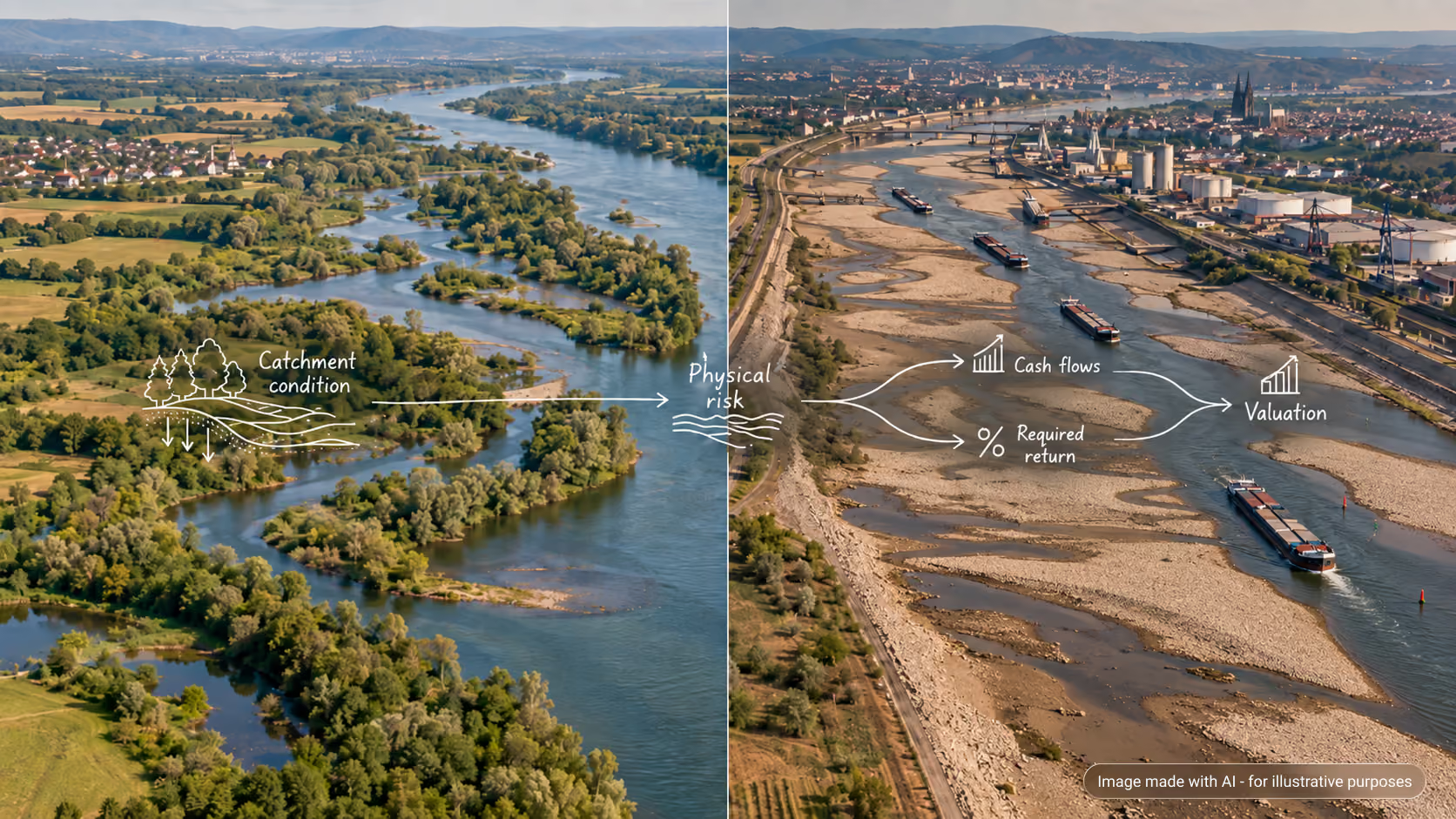
In August 2026, prolonged drought pushed the river Rhine to record low levels, constraining one of Europe’s most important industrial transport corridors. Around the Kaub chokepoint, exceptionally shallow water restricted navigation and forced vessels elsewhere on the river to operate with sharply reduced loads, while chemical producers, utilities, steelmakers, and agricultural traders reported higher freight costs, supply constraints, production disruption, and increasing dependence on more expensive road and rail alternatives.[1] The physical event propagated through otherwise distinct businesses because they shared a dependency on the same hydrological and transport system, turning a change in river conditions into a recognisable set of operating and economic consequences.
Once those consequences are visible, their location within a DCF model is relatively straightforward. Higher freight charges affect operating costs, constrained raw-material supply can reduce production and revenue, larger precautionary inventories affect working capital, and investment in alternative logistics or storage affects capital expenditure. The harder valuation problem arises where the physical risk is already known and credible but the resulting economic consequences are not yet specific enough to assign to a particular financial line item, year, and magnitude.
Physical risk can therefore be relevant to future economic outcomes before an equivalent loss has crystallised historically. Hazard, physical exposure, and physical vulnerability establish a distribution of possible physical impacts; dependency and operational flexibility determine how those impacts transmit into economic consequences. Where that transmission can be estimated with sufficient integrity, expected cash flows can incorporate it through direct assumptions or probability-weighted scenarios. Where it cannot, the uncertainty should be carried forward without forcing a line-item estimate beyond what the evidence supports. Any required-return treatment is a separate step, addressed later and developed in our white paper.[5]
What 2018 taught BASF, and what 2026 suggests about adaptation
BASF, the German chemical producer, experienced the economic consequences of extreme Rhine low water in 2018. For much of the third and fourth quarters of that year, raw-material deliveries to its Ludwigshafen site by inland waterway became severely restricted, forcing reductions in plant utilisation and lowering 2018 earnings by approximately €250 million over the year.[2] The event exposed a material dependency on Rhine transport and generated direct evidence of the mechanism through which a hydrological constraint could reach production volumes and earnings.
Following the 2018 episode, BASF invested in its ability to operate through future periods of low Rhine water. Its resilience measures included expanded recooling capacity, earlier warning of dry periods, more flexible multimodal transport, and additional low-water-capable vessels developed with shipping partners including Stolt Tankers, HGK Shipping, and GEFO.[3] These measures principally increased operational flexibility, allowing the Ludwigshafen operation to preserve more of its economic function when Rhine transport capacity was constrained. They were in place when severe low-water conditions returned in 2026.
When the Rhine again reached exceptionally low levels in this summer of 2026, BASF still experienced disruption, but management described the expected economic effect very differently from 2018. At its July 2026 half-year results, management said the resilience measures were paying off, that BASF was materially better prepared than in 2018, and that the expected economic impact was substantially lower, notwithstanding higher logistics costs and possible disruption.[3] ICIS reported force majeure on DINP and DPHP at Ludwigshafen in July, citing extreme hot and dry weather together with significant Rhine-related logistics constraints, and on several European surfactant lines in early August following raw-material delivery disruption led by low Rhine water. By late September, after the Rhine again reached record lows that week, BASF stated that it did not expect acute, major economic damage from the episode.[4]
The two episodes differ in duration, product mix, inventories, market conditions, alternative transport capacity, and timing, which prevents the difference in outcome from being attributed to adaptation alone. They nevertheless provide a useful illustration of the analytical distinction. The Rhine can remain severely stressed while the expected economic consequences for BASF change because the company’s operational flexibility has changed; at the same time, changes in the wider catchment can alter the hazard reaching Ludwigshafen, while the characteristics of BASF’s physical infrastructure can alter the vulnerability of its operations to a specified level of that hazard. A forward valuation therefore needs to consider both the evolution of physical risk and the mechanisms through which physical impairment becomes economically significant.
Physical risk becomes easier to allocate as the transmission becomes observable
The progression from physical risk to realised economic consequence changes the evidence available to the equity analyst. Before an event crystallises, evidence may establish the characteristics of the hazard, the physical exposure and vulnerability of the relevant business assets or systems, and the dependency of the business on the affected physical function, while the exact operating manifestation remains uncertain. Once disruption occurs, freight surcharges, lost production, inventory requirements, insurance effects, and management responses reveal more of the economic transmission through which physical impairment reaches the business.
Repeated observations deepen that mapping. The 2018 Rhine episode shows how severe low water affected Ludwigshafen under its operating configuration at the time, while the investments made thereafter and the 2026 episode add evidence on how operational flexibility has changed. A realised event therefore makes the transmission from physical risk to economic consequence easier to observe, without being a prerequisite for that relationship to be incorporated into a forward-looking valuation.
Valuation treatment should therefore follow the evidence available at the valuation date. Where physical and economic information supports a credible expected consequence, that consequence belongs in expected cash flows, either directly or through probability-weighted scenarios. Where the evidence cannot support that level of specificity, the analyst should avoid manufacturing a line-item estimate. The remaining risk then proceeds to a separate required-return assessment, governed by the valuation basis and by whether the relevant risk is already represented elsewhere; lack of cash-flow specificity alone does not determine its treatment.[5]
Resilience extends beyond the factory gate
BASF’s adaptations principally change the economic transmission of low-water conditions once they occur. Low-water vessels, alternative transport modes, forecasting systems, inventories, and related operating measures increase operational flexibility by preserving economic function under a hydrological constraint while leaving the underlying catchment largely unchanged. Their costs and benefits are comparatively easy to recognise because the company controls much of the expenditure and receives a relatively direct operating benefit.
The resilience of a river-dependent business is also influenced by the wider physical system on which it depends. For BASF, Rhine navigability is shaped by hydrological processes extending far beyond the Ludwigshafen site, so ecological and engineered conditions across the catchment can matter where they affect the probability, intensity, duration, timing, or spatial extent of the low-water conditions experienced by the business. The International Commission for the Protection of the Rhine reports that the Rhine has lost more than 85% of its natural overbank area through river training, straightening, diking, settlement, and other land-use changes, while intensive land use has also reduced water-retention capacity across the basin.[6] Wetland-restoration modelling finds that restoring drained soils can delay runoff, attenuate peak flows, and increase median catchment flows particularly in summer and autumn, with stronger local effects and smaller effects at broader basin scale.[7]
That evidence establishes a role for ecological condition within catchment hydrology. Its quantitative relevance to BASF’s 2026 experience remains unestablished; showing that a particular restoration programme would have prevented the low-water episode, raised navigable depth at Kaub by a specified amount, or reduced BASF’s losses by an identifiable figure would require location- and scale-specific hydrological modelling followed by economic transmission analysis. The economically relevant proposition supported by the evidence here is that soils, wetlands, floodplains, and other ecological systems can influence the physical processes governing water movement through the catchment, and their condition can therefore matter to businesses whose operations depend on the resulting hydrological function. Corporate resilience can accordingly extend beyond assets within the company’s own operational boundary. A business materially dependent on a river, watershed, agricultural landscape, or other ecosystem can have a rational economic interest in interventions that preserve or restore the ecological functions on which it relies.
The intervention should follow the mechanism through which risk is generated or transmitted. A low-water vessel may be the most effective response to a logistics bottleneck, while wetland restoration, floodplain reconnection, soil-water retention, or collective catchment management may be relevant where they can alter the hydrological processes contributing to low-water conditions in the first place. Action outside the factory gate becomes economically coherent where management can identify the dependency and establish a credible relationship between an intervention and the relevant physical function. The valuation challenge is that the company may bear a cost while part of the resulting resilience benefit is diffuse, shared with other users, or difficult to assign cleanly to a particular operating cash-flow line.
Following the mechanism into the financial model
Resilience expenditure enters the DCF through the financial lines affected by the intervention. For a company-controlled measure such as a low-water vessel, the expenditure enters capital expenditure or operating costs according to its form, while the resulting reduction in expected disruption can often be reflected through revenue, margins, working capital, or other cash-flow items. The analyst can therefore model both the cost and the attributable operating benefit using the same financial lines through which the intervention affects the business.
Landscape-scale resilience can be less straightforward. An ecological or engineered intervention may reduce physical risk by altering hazard, physical exposure, or physical vulnerability, while the resulting benefit to any one company can be shared across a catchment and difficult to isolate as a specific operating cash-flow effect. The cost should still be recognised in the DCF, together with any financial benefit that can be attributed with sufficient integrity; any remaining change in the risk borne by the investor then becomes relevant to the separate required-return assessment developed below.
What remains after the direct consequences have been allocated
Once sufficiently estimable economic consequences have been allocated to expected cash flows, a further question remains as to whether economically material physical risk is still missing from the valuation. Economic and asset-pricing theory provide routes through which physical risk can affect required return, while the evidence reviewed in the accompanying paper increasingly suggests that climate- and nature-related exposures are not always fully transmitted into historical market parameters or current prices.[5] Forward physical conditions can differ materially from those represented in historical data, while imperfect information, recognition, market participation, and institutional arrangements can leave economically relevant risk only partially reflected in conventional valuation inputs.
Our accompanying white paper develops the formal tests for that gap and distinguishes a market-level Physical Risk Premium, or PRP, from the Physical Risk Adjustment, or PRA, that we propose for holder-specific valuation.[5] The PRA is intended as a practical methodology for identifying and pricing an eligible residual where material physical risk remains outside sufficiently estimable expected cash flows and is not adequately represented in the baseline required return, subject to the applicable valuation, diversification, and double-counting tests. This denominator route is also important for resilience. Where an intervention produces a demonstrable reduction in the physical or economic risk underlying an eligible required-return effect, an updated assessment can support a lower adjustment, even where the intervention's private operating benefit is too diffuse to be represented fully in a specific cash-flow line. The valuation can therefore recognise part of the benefit of reducing the underlying risk through the denominator as well as the numerator.
As evidence improves, risk can migrate through the valuation
As evidence improves, the location of risk within the DCF can change. Better physical, economic, or operating evidence may make an economic consequence sufficiently estimable to move into expected cash flows; if the same effect was previously represented through an explicit required-return adjustment, that adjustment should reduce accordingly. Likewise, where systematic physical risk becomes reflected in beta, another market factor, or an empirically supported PRP, a separate adjustment for the same exposure should fall to prevent duplication.[5]
That migration is different from resilience itself. Better measurement changes how an unchanged risk is represented, while resilience changes the underlying risk through the mechanism it affects. Physical interventions can modify hazard, physical exposure, or physical vulnerability; operating measures can change economic risk through operational flexibility; and diversification can change the financial risk borne by a particular investor. Where an intervention genuinely changes the upstream physical- or economic-risk distribution, the updated assessment should flow through to any eligible required-return effect as well as to cash-flow consequences that can be estimated directly. Better information principally improves where and how unchanged risk is represented.
What changes once physical risk is inside the valuation
The value of this discipline lies in the decisions made from the valuation. Capital allocation depends on expected cash flows, valuations, hurdle rates, and required returns, so an economically material dependency that remains absent from those variables can make one investment appear more attractive simply because part of its risk has not entered the decision. Representing sufficiently estimable economic consequences in cash flows, and applying any required-return adjustment only after the relevant valuation tests have been satisfied, produces a more complete comparison of investments whose performance depends on different physical systems.
The same logic materially broadens the financial case for resilience beyond the factory gate. BASF's low-water vessels are comparatively easy to justify because the company controls the intervention and can capture a relatively direct operating benefit through lower disruption. A catchment-scale intervention can look less attractive if the company bears an opex or capex cost while the benefit is shared across users and cannot be attributed cleanly to a particular future cash-flow line. Once physical risk is represented in required return, however, a demonstrable reduction in that underlying risk can also reduce the eligible denominator effect and increase valuation. For a holder-specific PRA this means a lower required return for the relevant investor; where physical risk is reflected through a market-level PRP or other market parameter, the same logic can ultimately affect the company's market cost of equity. The denominator therefore provides an additional valuation pathway for resilience whose benefits are real but not fully captured through direct operating cash flows.
Nature-based interventions become particularly relevant where ecological condition forms part of the causal pathway. Degraded floodplains, soils, wetlands, forests, or other ecosystems may alter hazard or the physical vulnerability of business assets or systems; where the business materially depends on the affected physical function, an intervention that improves the relevant ecological condition can reduce physical risk and, through the mechanisms above, reduce expected economic consequences or an eligible required-return effect. The same evidentiary standard applies as for any resilience measure, with the intervention linked causally to the change in risk rather than credited with a valuation benefit merely because it produces wider environmental value.
Equity valuation is necessarily bounded by the channels through which ecological degradation reaches the company and investor under prevailing institutional arrangements. Some environmental costs remain external to the enterprise because current property rights, regulation, liability regimes, market structures, or information systems do not transmit them fully into private cash flows or required return. Those boundaries are not fixed; policy, litigation, ecosystem markets, insurance, disclosure, and improved market recognition can change the extent to which an ecological externality becomes financially relevant to the company or its investors.
Within that boundary, more complete physical-risk pricing can still improve outcomes for climate and nature by reducing the amount of economically relevant risk omitted from private decision-making. Where ecological degradation creates material exposure to the business or investor, recognising that exposure gives management a financial reason to consider interventions that strengthen the affected system even where the benefit is partly shared outside the company's operational boundary. As institutional and market arrangements evolve, some costs that are currently external can also move into the financial perimeter, making the relationship between ecosystem condition and private value progressively more explicit.
From physical information to capital allocation
The Rhine illustrates the sequence unusually well. The 2026 drought again converted a shared hydrological constraint into freight costs, supply disruption, and production risk, while BASF’s experience since 2018 shows how a company can respond by increasing operational flexibility. The wider catchment adds the ecological dimension because the physical systems supporting corporate resilience extend beyond company-owned infrastructure, and upstream land and water management can influence relevant hydrological functions without implying that any single intervention can automatically be credited with preventing a downstream loss.
A disciplined equity valuation follows that sequence as the evidence develops. Physical risk becomes economic risk through dependency and operational flexibility, with sufficiently estimable consequences entering expected cash flows. Material risk that remains outside the numerator is then tested separately for required-return relevance under the framework developed in the accompanying paper, including the PRA methodology where applicable.[5] Cash-flow and required-return effects both change value, but they represent different mechanisms and should not be double counted. Resilience acts upstream by changing physical risk or economic transmission, and an updated assessment can therefore change both the expected cash-flow consequences and any eligible denominator effect derived from that risk.
The practical objective is a more complete decision system in which physical risk enters the same financial information against which companies and investors allocate capital. Once expected cash flows and required returns reflect that risk through the mechanisms by which it reaches the business and investor, resilience expenditure can be assessed against both the expected economic consequences and the required-return effect it reduces. That is what broadens the investable resilience set beyond measures with an easily attributable private operating benefit, creating a valuation pathway for investment in the natural infrastructure outside the factory gate on which the business nevertheless depends.
References
[1] Reuters, “Low Rhine levels disrupting German industry,” 11 August 2026; Reuters, “German shippers warn Rhine could be ‘split in two’ by low water,” 9 August 2026; Reuters, “German economy hampered by depleted rivers, Bundesbank says,” 20 August 2026.
[2] BASF, 2018 annual-results materials, reporting that low Rhine water made raw-material deliveries by inland waterway nearly impossible for much of the third and fourth quarters and reduced 2018 earnings by approximately €250 million.
[3] BASF, “New low-water vessels for the supply of raw materials to BASF’s Ludwigshafen site,” 17 November 2021; BASF, Q2 2026 conference call and Q&A transcript, 29 July 2026, on low-water preparedness, specialised vessels, alternative transport, and management’s comparison with 2018.
[4] ICIS, “BASF flags possible force majeures, shortages as Rhine reaches record low levels,” 29 July 2026; ICIS, “Record low Rhine, Danube plus extreme heat cause force majeures and nuclear shutdowns,” 5 August 2026; Bloomberg, reported in Taipei Times, “Rhine’s dry-out has shippers rethinking their strategies,” 27 September 2026.
[5] The Landbanking Group, Climate- and Nature-Related Physical Risk in Equity Valuation: Allocation, evidence, and the transitional pricing of incompletely observed and transmitted risk, 2026.
[6] International Commission for the Protection of the Rhine, “Water retention,” documenting the loss of more than 85% of the Rhine’s natural overbank area and the reduction in natural water retention caused by land use and river engineering.
[7] Wetlands International Europe, Wetland restoration impact on streamflow in the Rhine River Basin, 2020, modelling hydrological effects of wetland restoration at micro- and macro-catchment scales.